Get Free Consultation!
We are ready to answer right now! Sign up for a free consultation.
I consent to the processing of personal data and agree with the user agreement and privacy policy


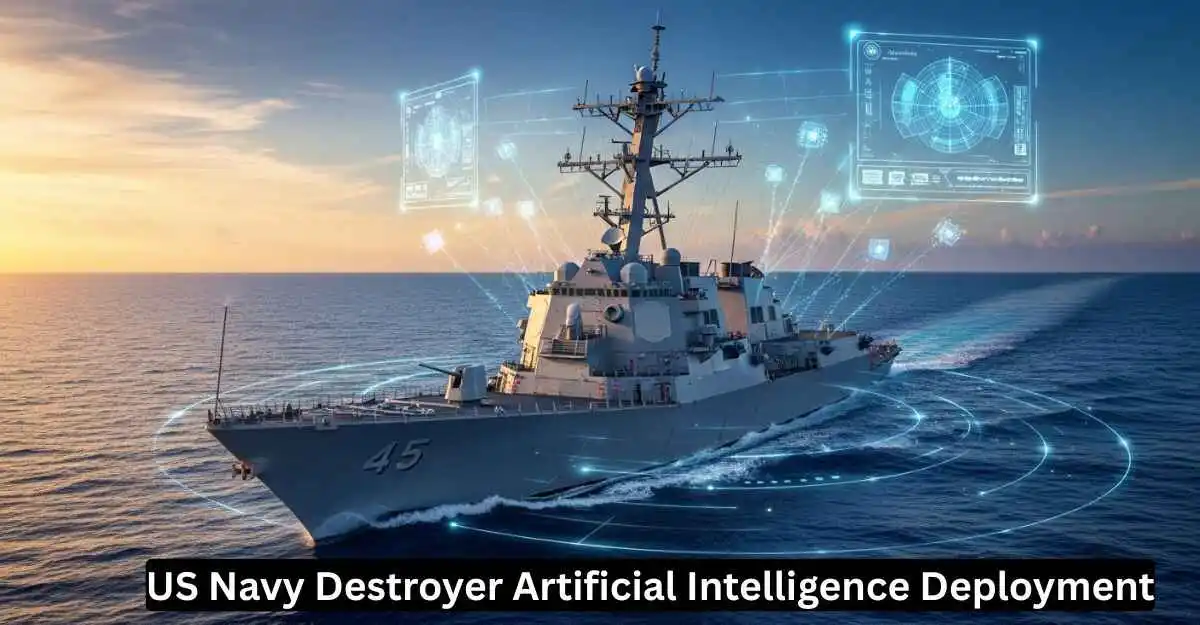
Firepower is no longer the only way to control oceans. Data and speed are as important today as radar and missiles. The US Navy Destroyer Artificial Intelligence Deployment is one of the most talked about developments in modern defense technology.
Artificial intelligence (AI), from faster threat detection systems to automated decision-support systems, is changing the way naval ships operate. It’s also redefining maritime security.
This article will explain AI deployment, its impact on destroyers, and why it is important. It will also show you how to confidently adopt or invest in similar advanced AI-driven defense solutions.
The United States Navy is known for its technological leadership. Modern naval warfare is far more complex. Modern naval warfare is more complex.
Due to this, the traditional decision-making process involving only humans is no longer sufficient.
Artificial intelligence in naval operations is the answer.
AI does not replace sailors but rather enhances their capabilities. It can process massive amounts of data in a matter of seconds and highlight what is important. Imagine giving your crew an assistant who is super intelligent and never tires.
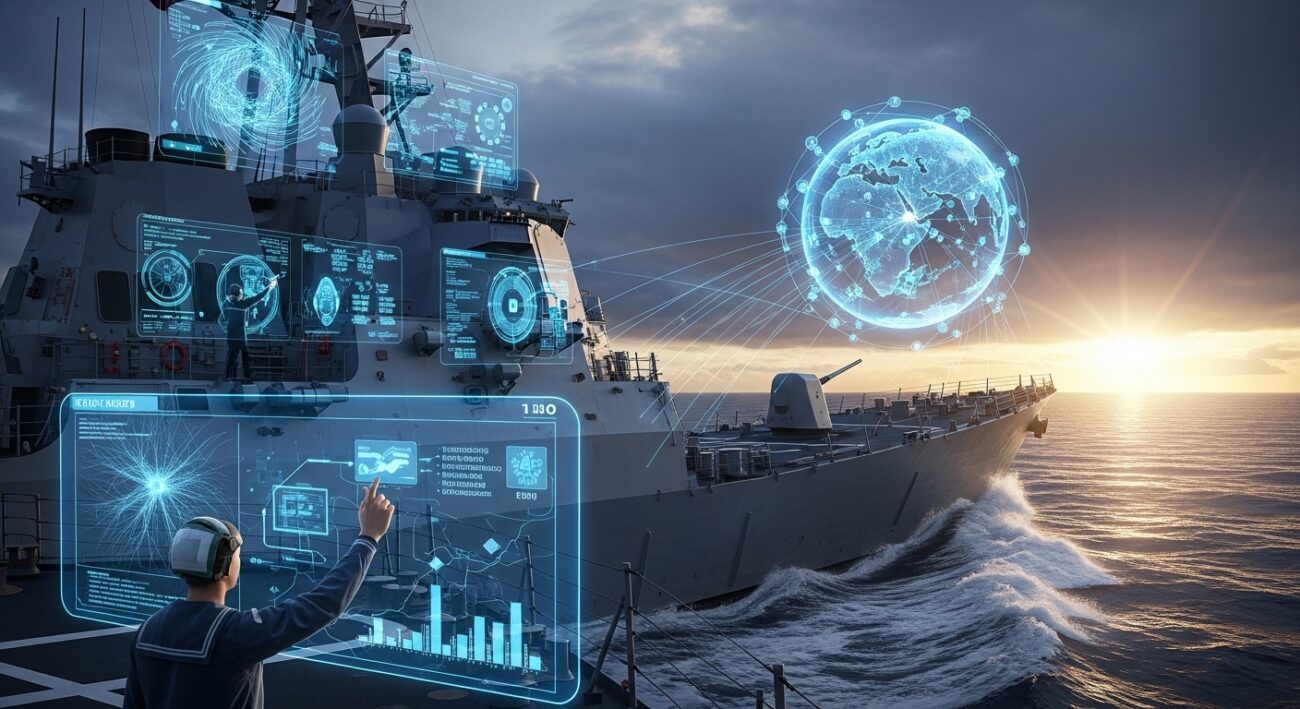
The destroyer, particularly advanced guided missile destroyers, is already equipped with powerful systems such as radar arrays and networked missile defense. AI deployment, however, upgrades these systems by:
Radar systems can scan thousands of signals. AI-powered systems can classify objects instantly, such as a bird or civilian aircraft.
What is the speed difference? Survival can be at stake.
The United States Department of Defense and its research arms, such as the Defense Advanced Research Projects Agency, have invested heavily in AI-driven military transformation.
Strategic planners at the Pentagon understand one simple fact:
Whoever processes information the fastest wins.
Defense contractors like Lockheed Martin, Raytheon Technologies, and others are building AI-integrated systems to strengthen naval dominance.
Simplify this.
Destroyers collect information from:
It creates massive streams of data every second.
AI systems are used:
The AI can filter out unwanted noise in milliseconds and highlight potential dangers.
The AI categorizes the following:
It presents only the most important information, rather than bombarding the crew with hundreds.
This is the most important part.
AI does NOT fire missiles by itself in most deployments. It provides:
Now, the human commander can make the final decision with unparalleled intelligence support.
AI systems improve over time.
The system will learn from a new drone attack. It will react even quicker the next time.
This is adaptive war capability.
Imagine a destroyer on patrol at night.
Radar picks up a number of fast-moving targets.
What are they? Drones? Coming missiles?
In older systems crew members had to manually analyze data. During the old systems, precious seconds were lost.
The AI-powered Maritime Defense Systems instantly analyzes movement, speed, radar signature, and shape.
In seconds:
The commander reacts instantly.
The time you save could be used to save hundreds of lives.US Navy Destroyer Artificial Intelligence Deployment
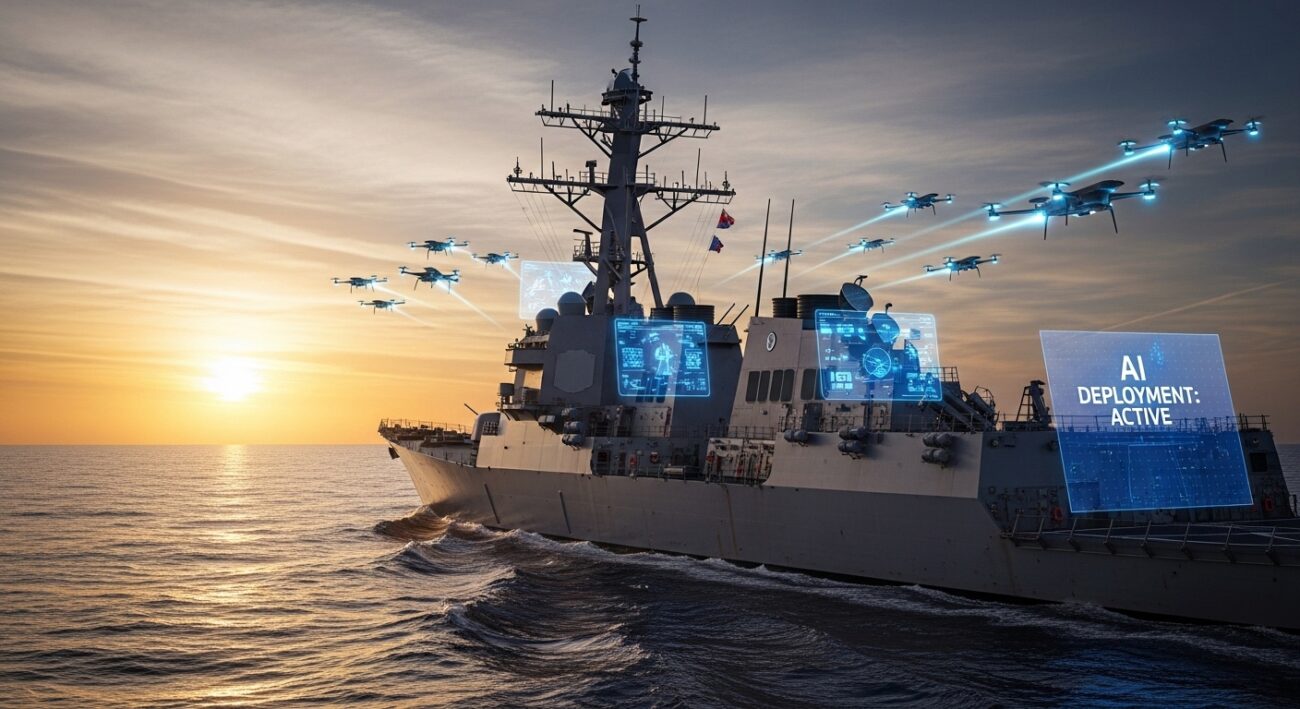
AI can reduce detection time to just seconds.
Human judgment is affected by fatigue and stress. AI remains consistent.
AI can detect abnormal behavior in networks and stop cyberattacks.
AI can predict issues in advance, so you don’t have to wait for your equipment to fail.
The increased operational readiness and reduced repair costs are both benefits.
Modern warfare includes
AI integrates all these domains to create a single decision-making network.
Many people are unaware of this:
The same AI technology used on naval destroyers can also be adapted to:
This is not only an innovation but also a great opportunity for those in the maritime security, defense, or AI sectors.US Navy Destroyer Artificial Intelligence Deployment
Here’s a quick guide for anyone who is a technology investor, a maritime security provider, or a defense contractor.
The global military AI budget is increasing every year. Smart defense systems are a priority for governments.
Search for solutions that:
Defense AI must adhere to strict security and ethical standards.
Experienced defense tech companies with large-scale deployment experience are ideal.
AI systems that are best suited to operational requirements will grow as they do.
This is a very common question.
The answer lies with human-in-the-loop systems.
AI is a tool that assists, but it does not replace the authority of command. The US Navy’s AI deployments are under strict human supervision in most cases.
Additional layers of cybersecurity protect against hacking attempts.
As AI systems develop, AI governance policies and ethical frameworks are strengthening.
When we discuss US Navy Destroyer Artificial Intelligence deployment we are not simply talking about software upgrades.
Here’s what we’re talking about
In modern naval warfare the person who controls the data controls the battlefield.US Navy Destroyer Artificial Intelligence Deployment
AI could enable:
For safety and accountability, it is likely that full autonomy will remain under the supervision of a human commander.
One of the biggest military changes in recent decades is the integration of AI on destroyers.
Combining: