Get Free Consultation!
We are ready to answer right now! Sign up for a free consultation.
I consent to the processing of personal data and agree with the user agreement and privacy policy


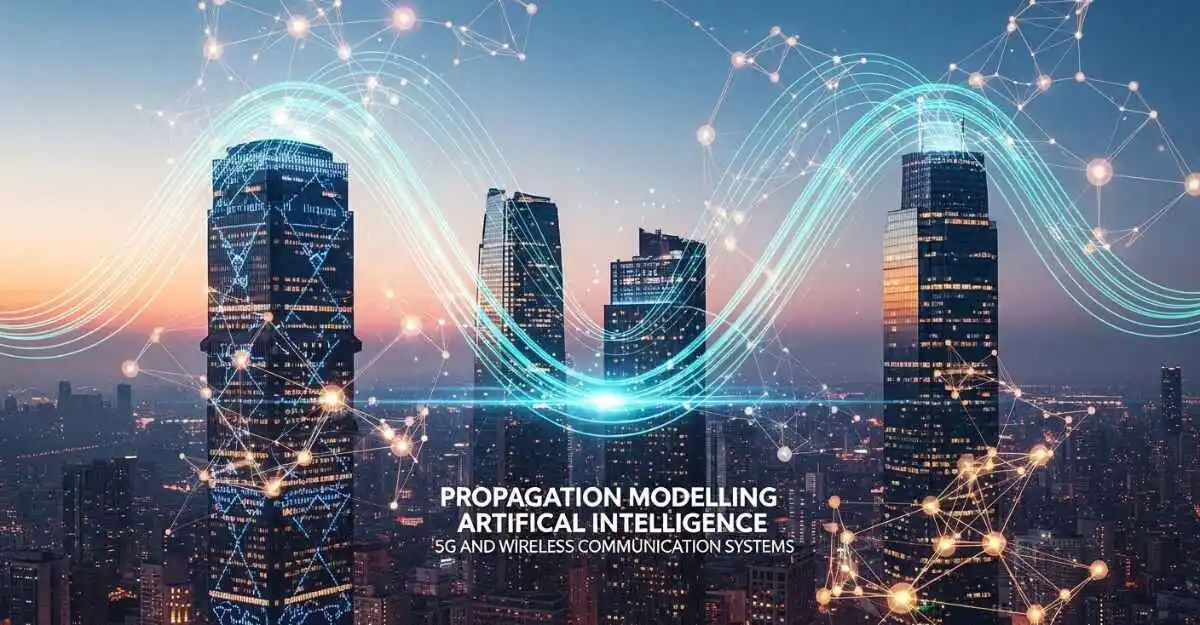
Propagation Modelling Artificial intelligence improves wireless networks using AI, ITU-R standards, and smart signal prediction for 5G and beyond. Keep networks safe in today’s connected society. This technology is responsible for your WiFi working seamlessly or your navigation remaining accurate in tall buildings.
This article explores propagation modeling, artificial intelligence, and its principles, applications, and the ITU standards that guide its use. This article will help you understand the importance of this technology for modern connectivity.
ITU propagation provides globally recognized guidelines to ensure consistent wireless network performance. These guidelines help engineers to predict the travel of electromagnetic waves in urban, rural, and indoor environments.
Engineers can maximize signal coverage, reduce interference, and increase data throughput by combining ITU recommendations for propagation with AI-powered models. So networks can work in any situation.
Learn more about ITU propagation guidelines: ITU

ITU-R P.530-17 describes methods for predicting loss of radio signal over terrestrial lines-of-sight. AI integration allows for real-time adaptability.
The AI-enhanced model accounts for:
This allows for accurate planning of cellular networks, WiFi, and IoT systems.
Learn more about ITU-R P.530-17: ITU 530
ITU-R SM 1448 is a set of empirical methods that can be used to predict the fading and reliability of microwave signals. These models, when combined with artificial intelligence and propagation modeling, can continuously improve their accuracy by learning from real-world measurements.
Included in the list of applications are
This results in fewer dead zones and improved network performance.
Read ITU-R SM 1448 details: ITU SM 1448
The ITU-R M series covers planning and evaluation of mobile networks. Integrating AI allows for:
This synergy makes mobile networks robust and reliable.
Explore the ITU-R: M Series
The International Telecommunication Union-Radiocommunication Sector sets standards for wireless communications to ensure interoperability across borders.
By aligning the propagation model with artificial intelligence to ITU standards, networks can achieve compliance and optimal performance.
Learn more about ITU-R
Resolutions are directives that provide radio frequency management, satellite communications, and propagation plans. These resolutions can be used by AI systems to automatically adjust propagation models and ensure compliance.
The following benefits are included:
Browse ITU Resolutions ITU Resolutions
ITU-617 standardizes intersatellite and space-to-earth links. AI propagation modeling allows engineers and scientists to accurately simulate satellite coverage, taking into account:
Satellite internet, remote sensing, and disaster response networks are all applications.
ITU 617 standard ITU617
ITU-R 1541 focuses on effective radiated power calculations. Integrating AI allows for:
AI-enhanced models of propagation are essential for improving the reliability of wireless systems in urban, rural, and indoor environments.
ITU SM1541: Learn more about SM1541. Propagation Modelling Artificial Intelligence
Here is a guide to Propagation Modelling Artificial Intelligence.
Measurements like
Tools: drones, signal mapping apps, and satellites.
Data is entered into:
The system can learn patterns in addition to traditional formulae.
What is machine learning? : Expert.ai
AI can learn:
In the same way, self-driving cars can learn traffic behavior.
Test AI predictions with real-world measurements in order to improve accuracy.
Once AI models are validated, they can assist in:
As data continues to flow in, it continually improves.
AI solutions for propagation modeling offer:
Accuracy—Outperforms Traditional Models Speed—Faster Network Deployment Scalability—From Indoor networks to Global Satellites Adaptiveness- Improves Over Time
This technology is essential for reliable wireless networks, smart cities, and next-generation connectivity.
Electromagnetic DeepRay (EM DeepRay) combines ray tracing with deep learning to enable accurate and fast propagation predictions.
Propagation modelling artificial intelligence is now essential. ITU standards, such as the M series, ITU 617, and SM1541, are no longer optional. This technology, which is used to keep video calls stable at malls and power smart cities, is quietly shaping the future of wireless communications.
Discover how the latest AI developments in April 2025 are making wireless networks smarter with Propagation Modelling Artificial Intelligence.